Explore Wisconsin’s wetlands
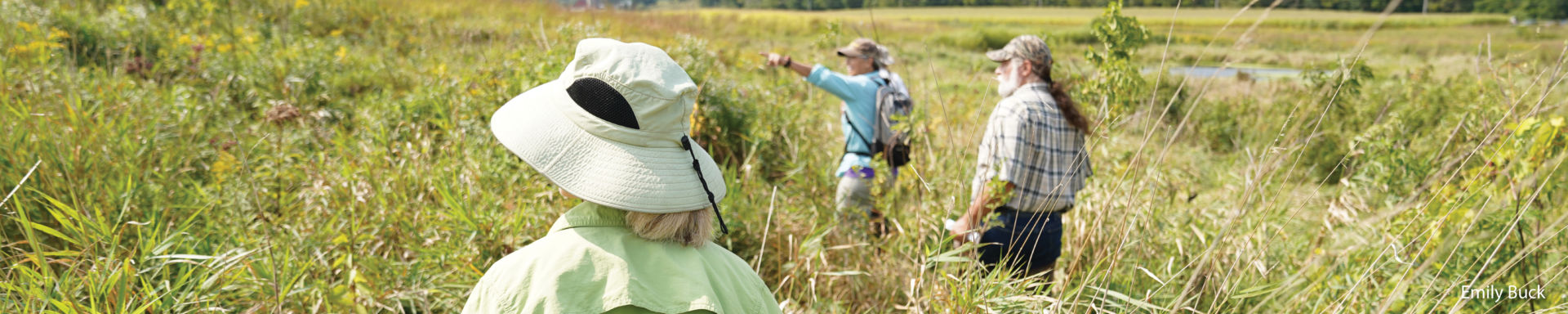
The best way you can get to know wetlands is by getting your boots wet while exploring them. Whether you like strolling on boardwalks or getting chest-deep in your waders, Wisconsin’s wetlands are ready for your discovery.
Visit a wetland
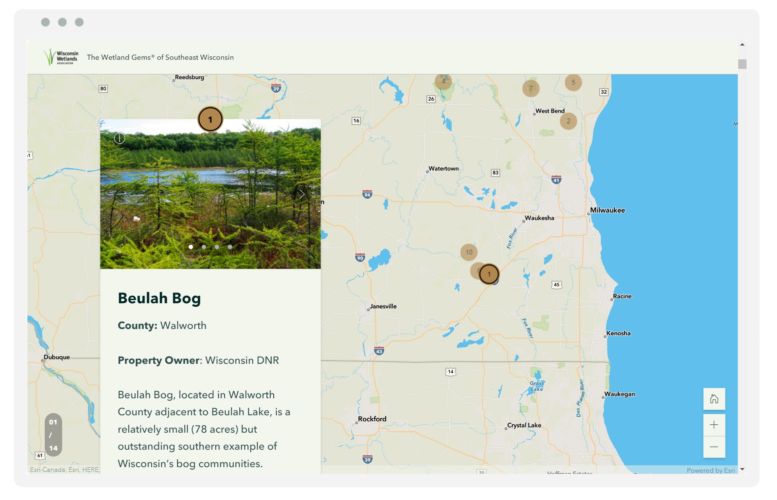
To help you find a healthy wetland to explore, we’ve highlighted 100 special wetland spots in Wisconsin and created a guide to each place. We call these places Wisconsin’s Wetland Gems®, and we invite you to start your explorations virtually with a series of interactive StoryMaps. Explore Wetland Gems® in eight regions within Wisconsin—one StoryMap for each region. Learn about each site, including the wetland community types and plant and animal species found there, and find links to more details including how to visit (note: the majority of Wetland Gems® are open to the public, but some are not). You’ll also find a link to a downloadable pdf fact sheet for each Wetland Gem® that you can print to take on your explorations.
Find a list of Wetland Gems® in each region using the boxes below.
Southeast Coastal Region
Explore the StoryMap for Wetland Gems® in Southeast coastal Wisconsin.
Chiwaukee Prairie
DesPlaines River Floodplain
Germantown Swamp
Renak Polak Woods
Root River Riverine Forest
Warnimont Bluff Fens
Central Region
Explore the StoryMap for Wetland Gems® in Central Wisconsin.
Bass Lake Fen and Lunch Creek Sedge Meadow
Bear Bluff Bog
Black RiverJay Creek
Blue Swamp
Cornstock Germania Marsh
Dewey Marsh
Jay Creek
Page Creek Marsh
Quincy Bluff Sohlberg Lake
Suk Cerney Wetlands
Summerton Bog
Northeast Region
Explore the StoryMap for Wetland Gems® in Northeast Wisconsin.
Black Ash Swamp
Brazeau Swamp
Hortonville Bog
Kangaroo Lake
Kohler Andrae Dunes
Mink River Estuary
Miscauno Cedar Swamp
Moonlight Bay
North Bay
Peshtigo River Delta
Point Beach and Dunes
Rushes Lake
Shivering Sands
West Shore Green Bay Wetlands
Wolf River
Northwest Region
Explore the StoryMap for Wetland Gems® in Northwest Wisconsin.
Belden Swamp
Black Lake Bog
Blomberg Lake
Blueberry Swamp
Brule Glacial Spillway
Crex Meadows
Empire Swamp
Erickson Creek Peatlands
Fish Lake Meadow
St. Croix Namekagon River Corridor
Southeast Region
Explore the StoryMap for Wetland Gems® in Southeast Wisconsin.
Beulah Bog
Cedarburg Bog
Cherokee Marsh
Horicon Marsh
Huiras Lake
Lulu Lake
Milwaukee River Floodplain
Nichols Creek
Rush Lake
Scuppernong River Area
Spruce Lake Bog
Sugar River Floodplain Forest
Waubesa Wetlands
White River Marsh
West Region
Explore the StoryMap for Wetland Gems® in West Wisconsin.
Big Swamp
Fort McCoy
Kickapoo Valley Reserve
Lower Chippewa River Delta
Lower St. Croix River Corridor
Lower Wisconsin River Wyalusing
Oak Ridge Lake
Snow Bottoms
Trempealeau River Sedge Meadow
Upper Miss. Trempealeau River
Van Loon Bottoms
Whitman Bottoms
North Central Region
Explore the StoryMap for Wetland Gems® in North Central Wisconsin.
Atkins Lake Hiles Swamp
Bear Lake Sedge Meadow
Bogus Swamp
Flambeau River State Forest
Grandma Lake
Hunting River Alders
Jump Mondeaux River Floodplain
Kissick Alkaline Bog
Rice Creek
Savage Robago Lakes
Spider Lake
Toy Lake Swamp
Turtle-Flambeau-Manitowish Peatlands
Superior Region
Explore the StoryMap for Wetland Gems® in the Superior region of Wisconsin.
Bark Bay and Lost Creek Bog
Bibon Swamp
Big Bay
Kakagon Bad River Sloughs
Nemadji Floodplain Forest
Outer Island Sandspit and Lagoon
Pokegama Carnegie Wetlands
Red Cliff Raspberry Bay
Sand Bay
St. Louis River Marshes
Stockton Island Tombolo
Sultz Swamp
Workhorse wetlands
We have also highlighted seven valuable wetlands providing a variety of natural benefits to our communities, waters, and wildlife. Click the box at right for the list of these sites and the natural benefits each site highlights. Click the link to explore a StoryMap with more details about each site and natural benefit.
Workhorse wetlands
Explore the StoryMap for workhouse Wetland Gems®.
Turtle Valley: Wildlife Habitat
Spoehr’s Marsh: Fishery Habitat
MMSD Greenseams Program: Flood Attenuation
Halfway Creek Marsh: Water Quality Protection
Oconto Marsh: Shoreline Protection
Pheasant Branch: Groundwater Connections
Mead Wildlife Area: Recreation & Education
Wetlands of International Importance
While all of Wisconsin’s wetlands are important, we’ve worked to nominate some of the state’s most special wetlands for designation as Wetlands of International Importance to celebrate these wetlands and ensure their long-term protection. This designation is awarded by the Ramsar Convention on Wetlands, an international organization that encourages wetland protection and management. We’re proud to have helped bring this prestigious designation to some of Wisconsin’s special wetlands.
Learn more about Wisconsin’s Wetlands of International Importance

How can I tell if I’m standing in a wetland?
Wetlands are found all across Wisconsin and come in many different sizes and types. Some wetlands, like large open marshes, are obvious. Some wetlands, like forested ephemeral ponds, may be harder to spot. Here are a few tips for recognizing a wetland:
- The presence of water-loving plants: Look for plants that love wet soil or water, like cattails, sedges, marsh marigold, and more
- Wetland soil: The soil in a wetland often appears darker than upland soils. The soils may also show rust spots or be grayish or bluish gray. While many wetlands have muck or peat soils, wetland soils can also be comprised of silt, clay, and sand.
- Hydrology indicators: If you are in a low-lying area with standing water or soggy soil, you’re likely in a wetland.
- Clues from surrounding trees: Shallow root systems and water mark stains on tree trunks can mean you are in a wetland, even if the ground is currently dry.